

The Implementation Science Centers in Cancer Control (ISC3) Program is an initiative supporting the development, testing, and refinement of innovative approaches to implement evidence-based cancer control interventions.
All Centers feature "implementation laboratories" involving clinical and community sites. These sites engage in implementation research across the cancer control continuum to:
- advance methods in studying implementation
- develop and validate reliable measures of key implementation science constructs.
Research activities for the Centers are organized around a cohesive, overarching implementation science theme that frames their activities and research agenda.
Implementation Science Centers (P50s)
The ISC3 Program is composed of seven Centers funded by RFA-CA-19-005 and RFA-CA-19-006.
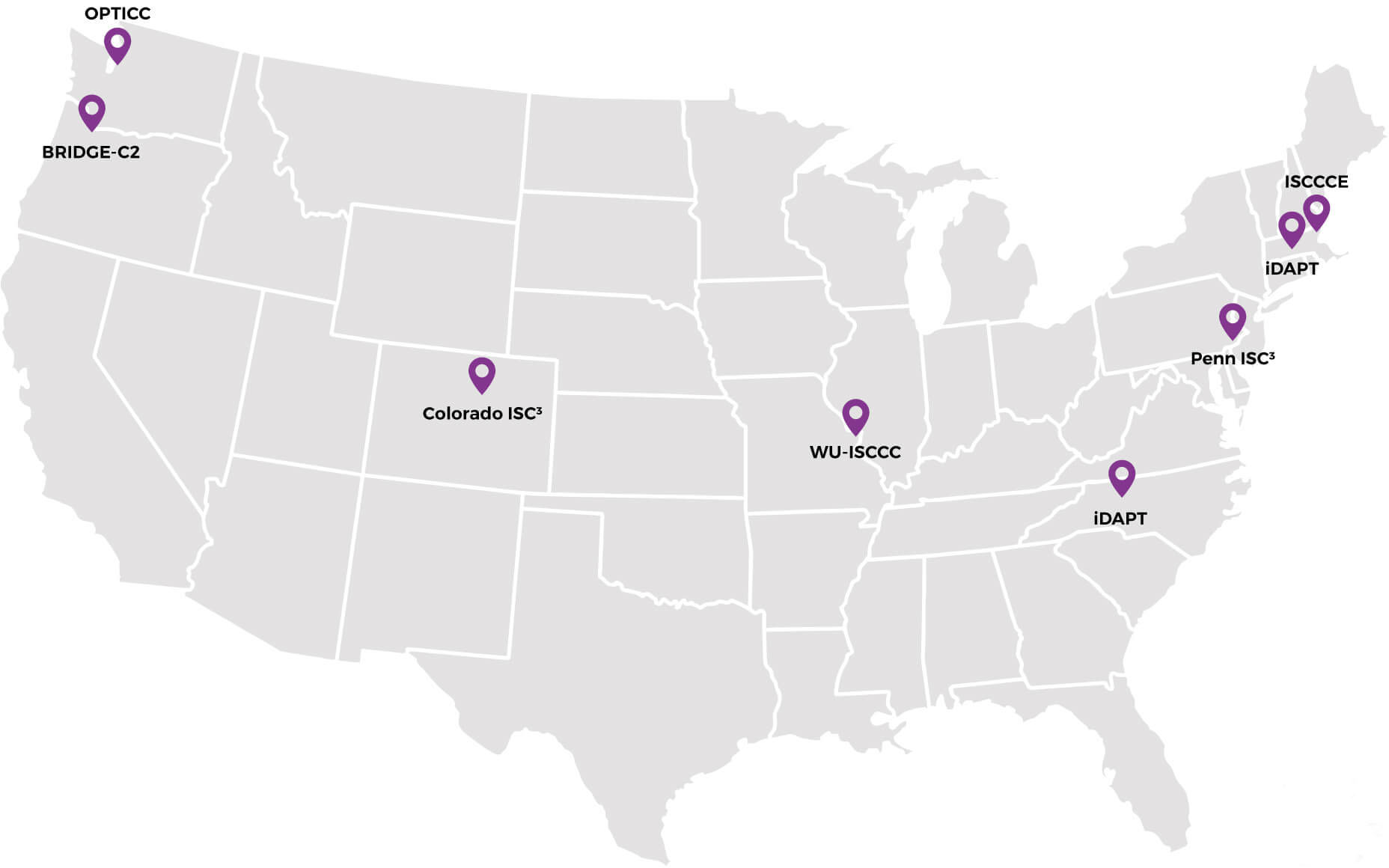
Colorado ISC3
Grant #: 1 P50 CA244688-01
Principal Investigator: Russell E. Glasgow, PhD
Institution: University of Colorado School of Medicine
Theme: Advancing pragmatic implementation science approaches to assess and enhance the value of cancer prevention and control in rural primary care
ISCCCE
Grant #: 1 P50 CA244433-01
Multiple Principal Investigators: Karen Emmons, PhD, Elsie Taveras, MD, MPH
Institution: Harvard T.H. Chan School of Public Health
Theme: Improving community health by integrating implementation science for evidence-based cancer control
BRIDGE-C2
Grant #: 1 P50 CA244289-01
Multiple Principal Investigators: Jennifer DeVoe, MD, DPhil, Nathalie Huguet, PhD
Institution: Oregon Health & Science University
Theme: Advancing implementation science to improve cancer screening and prevention in underserved populations
Penn ISC3
Grant #: 1 P50 CA244690-01
Multiple Principal Investigators: Rinad Beidas, PhD, Justin Bekelman, MD, Robert Schnoll, PhD
Institution: University of Pennsylvania/Northwestern University
Theme: Applying insights from behavioral economics to rapidly accelerate the pace at which evidence-based practices for cancer care are deployed and the extent to which they are delivered equitably, thereby increasing their reach and impact on the health and health equity of individuals with cancer
OPTICC
Grant #: 1 P50 CA244432-01
Multiple Principal Investigators: Bryan J. Weiner, PhD, Margaret Hannon, PhD, MPH, Cara C. Lewis, PhD
Institution: University of Washington
Theme: Improving cancer outcomes through optimized evidence-based intervention implementation in community and clinical settings across the continuum of cancer treatment and care
iDAPT
Grant #: 1 P50 CA244693-01
Multiple Principal Investigators: Kristie Long Foley, PhD, Thomas K. Houston II, MD, MPH, Sarah L. Cutrona, MD, MPH
Institution: Wake Forest School of Medicine/University of Massachusetts Medical School
Theme: Advancing the field of implementation science by using technologies to support rapid cycle and real-time deployment and testing of implementation processes and adaptations within cancer control
WU-ISCCC
Grant #: 1 P50 CA244431-01
Multiple Principal Investigators: Ross C. Brownson, PhD, Graham A. Colditz, MD, DrPH
Institution: Washington University in St. Louis
Theme: Advancing rapid-cycle implementation research to increase the reach, external validity and sustainability of effective cancer control interventions, also utilizing system science approaches to enhance methods and outcomes in implementation science