

C3I Public Use Policy
The National Cancer Institute (NCI) has a long-standing commitment to reducing the use of tobacco and its detrimental effects on public health. The Cancer Center Cessation Initiative (C3I) was launched in 2017 with the long-term goal to help cancer centers build and implement sustainable tobacco cessation treatment programs to routinely address tobacco cessation with cancer patients.
There were 52 funded NCI-Designated Cancer Centers, with a coordinating center based at the University of Wisconsin. The coordinating center collected data from C3I centers via a web-based Qualtrics survey in 6-month reporting periods from January-June 2017 to July-December 2022. The biannual reporting is described in more detail in D'Angelo et al, Cancer Pre Res (Phila), 2019  .
.
Accordingly, NCI has established a public use dataset. More information about the C3I initiative that generated these data is available through the following website: Cancer Center Cessation Initiative. Data are aggregated to the level of the cancer center, and cancer centers have been de-identified. No patient-level data are available.
To facilitate research with the C3I data sets, NCI will make efforts to delineate and make available to potential users the limitations of C3I data. Potential users are directed to review the resources in the next section, which include the PDFs of the surveys, the codebook, and more.
C3I Public Use Data Resources
NCI is committed to the broad sharing of C3I research results to further research and to promote public health. Data are aggregated to the level of the cancer center, and cancer centers have been de-identified. No patient-level data are available. The following resources include the codebook and surveys that correlate with the C3I data set.
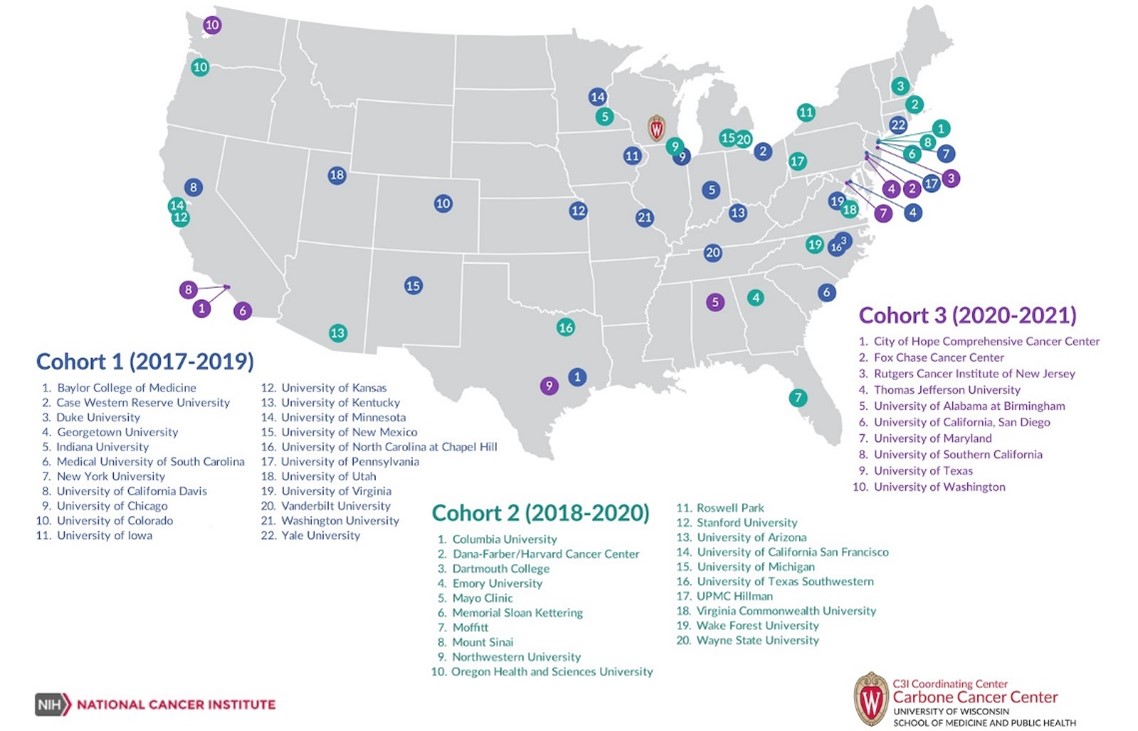
Initially conceptualized as a one-time Request for Proposals for a two-year program, C3I grew to fund 52 NCI-designated Cancer Centers, representing 81% of the 64 NCI-designated comprehensive and clinical cancer centers, in three successive cohorts. Funding was provided via administrative supplements to the applicants' NCI-funded P30 Cancer Center Support Grant (CCSG).
The first cohort consisted of 22 centers (2017-2019), the second cohort added 20 centers (2018-2020), while the third cohort included 10 centers (2020-2021). Cohorts 1 and 2 received two-year supplements. Cohort 3 received one-year supplements. Cohort 3 was funded for one year with the goal of leveraging lessons learned from Cohorts 1 and 2 to accelerate implementation. Additionally, Cohort 1 and 2 sites were eligible to apply for a one-time Enhancement Program, providing additional funding for the enhancement of the reach and effectiveness of their programs for the 2020-2021 timeframe; 11 centers received Enhancement awards.
The coordinating center of the initiative is based at the University of Wisconsin-Madison. The role of the coordinating center was to support C3I grantees by:
- Providing technical assistance in the areas of electronic health record (EHR) integration, clinical workflow change management, and addressing health disparities as they relate to the delivery of tobacco cessation treatment services;
- Serving as the hub of knowledge integration, including sharing best practices across participating centers and the cancer clinical and research community more broadly;
- Collecting and analyzing tobacco treatment program (TTP) characteristics and outcomes data from funded centers and disseminating results on reach and effectiveness to share the impact of the initiative.
Codebook and Data Considerations
In 2024, the coordinating center finalized harmonization of the five-year C3I data collection. The codebook reflects the final combined dataset in CSV format.
Surveys
As part of the initiative, the coordinating center collected program data from C3I-funded centers every six months via a web-based Qualtrics survey. Each C3I center also submitted a pre-grant baseline report to the coordinating Center soon after initial receipt of C3I funding. Cohorts 1 and 2 submitted baseline data for the six-month period prior to the start of their funding; Cohort 3 submitted baseline data for the six-month period 18 months prior to the start of their funding (January 1, 2019 - June 30, 2019) to avoid the limitations of reporting baseline data from the beginning of the COVID-19 pandemic (January 1, 2020 - June 30, 2020).
The C3I Biannual Report was developed by the coordinating center team in collaboration with a panel of tobacco cessation experts. Measures were informed by the RE-AIM Framework (Reach, Effectiveness, Adoption, Implementation, and Maintenance), the application of which is described in more detail here . The report was modified over time by the coordinating center scientist who led the development of common measures, data collection and management, and knowledge dissemination efforts for the initiative. Modifications to the report are described in the "Key Additions and Revisions Across Reporting Periods".
In the C3I Biannual Report, survey items assessed cancer center and tobacco treatment program (TTP) characteristics (e.g., services offered, screening and referral methods, staffing), adoption, and implementation status, and asked centers to report program reach and effectiveness among patients for the six-month reporting period. Each cancer center submitted only one survey response at each reporting period. Cancer centers could report reach and effectiveness data for up to three separate settings within their center. All data were aggregated at the center level (i.e., across services); all reported settings, cancer-specific and otherwise, were included in this aggregation. No individual patient information was ever shared as part of C3I reports. This table provides an overview of measures regularly assessed in the Biannual Report. PDF copies of surveys, reporting protocols, and data worksheets for all reporting periods are available for review.
Cohort 1: January 1 - June 30 Pre-Grant Baseline Survey
Cohort 1: January 1 - June 30 Survey
Cohort 2: January 1 - June 30 Pre-Grant Baseline Survey
Cohort 1: July 1 - December 31 Survey
Cohort 1 and 2: January 1 - June 30 Survey
Cohort 3: January 1 - June 30 Pre-Grant Baseline Survey
Cohort 1 and 2: July 1 - December 31
Cohort 1 and 2: January 1 - June 30 Survey
Cohort 1 and 2: July 1 - December 31 Survey
Cohort 1, 2, and 3: January 1 - June 30 Survey
Cohort 1, 2, and 3: July 1 - December 31 Survey
Cohort 1, 2, and 3: January 1 - December 31 Survey
Related Publications
- D'Angelo H, Rolland B, Adsit R, Baker TB, Rosenblum M, Pauk D, Morgan GD, Fiore MC. Tobacco Treatment Program Implementation at NCI Cancer Centers: Progress of the NCI Cancer Moonshot-Funded Cancer Center Cessation Initiative. Cancer Prev Res (Phila). 2019 Nov;12(11):735-740.
- D'Angelo H, Ramsey AT, Rolland B, Chen LS, Bernstein SL, Fucito LM, Webb Hooper M, Adsit R, Pauk D, Rosenblum MS, Cinciripini PM, Joseph A, Ostroff JS, Warren GW, Fiore MC, Baker TB. Pragmatic Application of the RE-AIM Framework to Evaluate the Implementation of Tobacco Cessation Programs Within NCI-Designated Cancer Centers. Front Public Health. 2020 Jun 12;8:221.
- D'Angelo H, Webb Hooper M, Burris JL, Rolland B, Adsit R, Pauk D, Rosenblum M, Fiore MC, Baker TB. Achieving Equity in the Reach of Smoking Cessation Services Within the NCI Cancer Moonshot-Funded Cancer Center Cessation Initiative. Health Equity. 2021 Jun 16;5(1):424-430.
- D'Angelo H, Land SR, Mayne RG. Assessing Electronic Nicotine Delivery Systems Use at NCI-Designated Cancer Centers in the Cancer Moonshot-funded Cancer Center Cessation Initiative. Cancer Prev Res (Phila). 2021 Aug;14(8):763-766.
- Hohl SD, Matulewicz RS, Salloum RG, Ostroff JS, Baker TB, Schnoll R, Warren G, Bernstein SL, Minion M, Lenhoff K, Dahl N, Juon HS, Tsosie U, Fleisher L, D'Angelo H, Ramsey AT, Ashing KT, Rolland B, Nolan MB, Bird JE, Nguyen CVT, Pauk D, Adsit RT, Tindle HA, Shoenbill K, Yeung S, Presant CA, Wiseman KP, Wen KY, Chichester LA, Chen LS. Integrating Tobacco Treatment Into Oncology Care: Reach and Effectiveness of Evidence-Based Tobacco Treatment Across National Cancer Institute-Designated Cancer Centers. J Clin Oncol. 2023 May 20;41(15):2756-2766.
- Hohl SD, Bird JE, Nguyen CVT, D'Angelo H, Minion M, Pauk D, Adsit RT, Fiore M, Nolan MB, Rolland B. Operationalizing Leadership and Clinician Buy-In to Implement Evidence-Based Tobacco Treatment Programs in Routine Oncology Care: A Mixed-Method Study of the U.S. Cancer Center Cessation Initiative. Curr Oncol. 2022 Mar 29;29(4):2406-2421.
- D'Angelo H, Hohl SD, Rolland B, Adsit RT, Pauk D, Fiore MC, Baker TB. Reach and effectiveness of the NCI Cancer Moonshot-funded Cancer Center Cessation Initiative. Transl Behav Med. 2022 May 26;12(5):688-692.