

Dear Colleagues,

Greetings to everyone in our research community. For a variety of reasons it has been a while since our last scientific bulletin, so I beg your indulgence given the length of this one and the inclusion of some older updates. We are thrilled to be back at work after the recent government shutdown and hope to see another continuing resolution or full-year budget appropriation by January 30.
Let me begin with a few leadership highlights. Just prior to the start of the fiscal year, Dr. Anthony Letai was sworn into office as our new NCI director. He has since hosted an NCI Town Hall to share a bit of his vision for cancer research, and we expect to hear more about this in the coming months. Specific to the Division of Cancer Control and Population Sciences (DCCPS), it has already almost been a year since the Healthcare Delivery Research Program welcomed Dr. Janet de Moor as its permanent associate director. Dr. de Moor was previously the program’s deputy associate director and then moved to acting associate director prior to her transition. We have also seen the departure of Dr. Emily Tonorezos as director of the Office of Cancer Survivorship (OCS). Very recently, our DCCPS Director Dr. Katrina Goddard shared that she will be stepping down as director. Deputy Director Dr. Gary Ellison will be serving as acting division director moving forward.
Now a few words about grants policies. Our program staff strive to provide exceptional support for our current and prospective grantees, particularly given recent dynamic changes. We are here to support you to the best of our ability and encourage you to reach out with any questions or just for us to lend an ear, and we will do the best we can to answer any questions. Cancer affects us all, and we continue to fund and support research toward the mission of ending cancer as we know it.
As a reminder, Grants.gov will serve as NIH’s single official source for grant and cooperative agreement funding opportunities. NIH no longer posts notices of funding opportunities (NOFOs) to the NIH guide. Learn more here, and be sure to bookmark Grants.gov in order to stay up-to-date on NOFOs. Apply through an appropriate funding opportunity, such as NIH Parent Funding Announcement, or other opportunities through Grants.gov. Remember to reach out early to the appropriate scientific contacts to discuss how your research idea may align with the topics, appropriate parent funding opportunities, and other questions related to your application. We are open to all ideas, though please note that the amount of funding awarded will depend on the availability of funds, the number of meritorious applications, and competing priorities. You can learn more about the grant and funding process as well as current policies here and additional research funding opportunities here.
At the September 2025 NCAB meeting, NIH Director Dr. Jay Bhattacharya presented a “unified grant funding policy.” NIH is moving away from a strict payline-based funding model such as that adopted by some institutes, including NCI. In addition to peer review, factors will be considered for funding such as alignment with NCI’s mission and strategic priorities, how the proposal contributes to the balance within NCI’s overall research portfolio, and the investigator’s career stage and sustainability of the biomedical work force. View this presentation here.
Highlighting resources we provide to the scientific community, I am delighted to announce that the Health Information National Trends Survey (HINTS) team has released HINTS 7 (2024) data as well as a new Brief. The Tobacco Use Supplement to the Current Population Survey (TUS-CPS) team has released the full 2022-2023 dataset and an accompanying harmonized data set. Within each of these releases is a fact sheet for more information. Questions about using these data? Feel free to contact our Behavioral Research Program inbox for assistance.
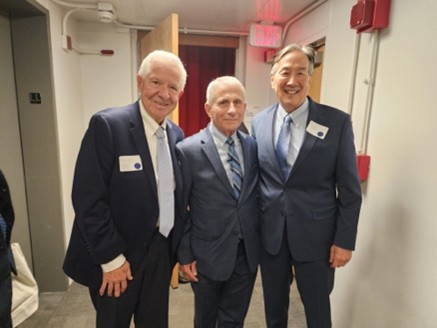
I’d like to share a few awards received by grantees in recent months. Dr. Michael Fiore was one of two recipients of the Harvard School of Public Health annual Alumni Merit Award, their highest honor for alumni. Dr. Fiore is pictured here with Dr. Anthony Fauci, who was the featured guest at the celebration and gave remarks.
In 2024, DCCPS established the Paul Fearn Award for Excellence in Data Sharing to recognize DCCPS-funded grantees, past and present, who have demonstrated commitment to and excellence in data sharing. The award is named posthumously for Dr. Paul Fearn, who was a cross-agency champion of data linkages, data provenance, data integration, and data security. For the first year of the award (2025), DCCPS acknowledged Dr. James Lacey, Dr. Christopher Amos, Drs. Christopher Haiman, Esther John, Peter Kraft, Sara Lindstroem, Wei Zheng, and Elad Ziv, and Dr. Diana Miglioretti for their commitment to widespread data sharing, surpassing the data sharing requirements at the time of their funding. See below for specific details on these projects.
The current issue includes expiring funding opportunities, resources in addition to the above, and scientific advances from staff and grantees.
Our colleagues in the Surveillance Research Program have released an updated Cancer Trends Progress Report, as well as updated data on preliminary cancer incidence rates and trends. I encourage you to take a look.
You can always find data resources and upcoming events on our website.
We appreciate your feedback, and as a reminder, you may manage your BRP newsletter subscription at any time. We hope you find the information beneficial.
All the best,
Bill Klein
Associate Director of Behavioral Research
Expiring Funding Opportunities
Digital Health Technology Derived Biomarkers and Outcome Assessments for Remote Monitoring and Endpoint Development
PAR-25-170 (UG3/UH3 Clinical Trial Optional)
NCI Contact: Dana Wolff-Hughes
Posted: November 13, 2024
Close Date: June 22, 2026
Tobacco Regulatory Science Small Grant Program for New Investigators
RFA-OD-25-008 (R03 Clinical Trial Optional)
NCI Contact: Maria Roditis
Posted: June 24, 2025
Close Date: July 14, 2026
Resources
New HINTS 7 (2024) Data Are Available for Download
The Health Information National Trends Survey (HINTS) Management Team has released HINTS 7 (2024) data. In addition to the traditional items on health communication, the use of digital technology, and cancer risk awareness for which HINTS is known, HINTS 7 (2024) also covers new topics such as experiences with telehealth, multi-cancer detection tests, clinical trials, and cognitive impairment. HINTS 7 (2024) was fielded from March through September 2024 (N=7,278). The public-use dataset is available in SAS, SPSS, STATA, and R formats. Access HINTS 7 (2024) Data.
HINTS Brief 57: Clinical Trial Knowledge, Discussion, and Participation Among Cancer Survivors Now Available
The HINTS Brief 57 “Clinical Trial Knowledge, Discussion, and Participation Among Cancer Survivors” examines knowledge of, discussions about, and participation in clinical trials among a sample of cancer survivors drawn from three registries. View HINTS Brief 57. View HINTS Brief page.
Full 2022-2023 TUS-CPS Dataset Now Available
The full 2022-2023 Tobacco Use Supplement to the Current Population Survey (TUS-CPS) dataset, consisting of September 2022, January 2023, and May 2023 data, is now publicly available. Accompanying these data is a data brief presenting a synopsis of results for all three timepoints, as well as a fact sheet with more information on the TUS-CPS covered topics and survey design. Access TUS-CPS Data. View Data Brief. View Fact Sheet.
TUS-CPS Harmonized Dataset Now Available
An updated harmonized dataset containing data from all available waves (1992 through 2023) provides a more robust data source, allowing for increased sample size and improved tracking of trends over time. Harmonized variables cover a wide range of topics, including, but not limited to, cigarette and e-cigarette use, workplace and home smoking restrictions, attitudes toward smokefree rules, advice to quit by physician/dentist, health perceptions and beliefs, and other tobacco product use. Access the Harmonized Dataset. View Fact Sheet.
Updated Cancer Trends Progress Report Available
The Cancer Trends Progress Report, continually updated since its first issue in 2001, summarizes our nation's advances against cancer in relation to Healthy People targets set forth by the Department of Health and Human Services. The report, intended for policy makers, researchers, and public health professionals, includes key measures of progress along the cancer control continuum and uses national trend data to illustrate where improvements have been made and where attention is warranted. A new measure this year is Children's Physical Activity. Access the Cancer Trends Progress Report.
Updated Preliminary Cancer Incidence Rates and Trends
The NCI Surveillance Research Program has updated the Surveillance, Epidemiology, and End Results (SEER) website to include the Preliminary Cancer Incidence Rates and Trends, 2000-2023.
SEER*Explorer now has the following:
- Preliminary Incidence Rates through 2023
- Long-term trends in Survival
- Mortality estimates by Rural Urban Continuum Code
Preliminary estimates can help to identify expected patterns earlier than one could otherwise and can help guide research and facilitate more prompt attention to areas of concern. View Preliminary Cancer Incidence Rates and Trends. Access SEER*Explorer.
National Cancer Institute FY24 Fact Book Now Available
The NCI Budget Fact Book provides a summary of the distribution of the fiscal year 2024 budget among the various NCI research programs and funding mechanisms, funding policies influencing grant awards, as well as comparisons with prior year allocations. View the NCI Budget Fact Book.
FY27 Annual Plan and Professional Judgement Budget Now Available
NCI has released its Professional Judgement Budget Proposal for FY27. It describes the resources needed to ensure that the cancer research enterprise stays strong, delivers on the opportunities before us, and changes what it means to have cancer. View the Annual Plan and Budget.
Scientific Advances
Shiels MS, Freedman ND, Haque AT, et al. U.S. cancer deaths prevented due to survival improvements stratified by extent of disease, 2010-2019. J Natl Cancer Inst. Published online July 16, 2025. doi:10.1093/jnci/djaf192
Luo C, Khan S, Jin L, James AS, Colditz GA, Drake BF. Where should the cancer control interventions target: a geospatial hotspot analysis for major cancer mortality 2018 to 2022 in the United States. Cancer Epidemiol Biomarkers Prev. 2025;34(7):1074-1079. doi:10.1158/1055-9965.EPI-24-0957
Kaur N, Gonzales Iv M, Alcaraz CG, Gong J, Wells KJ, Barnes LE. A computational framework for longitudinal medication adherence prediction in breast cancer survivors: a social cognitive theory based approach. PLOS Digit Health. 2025;4(6):e0000839. Published 2025 Jun 10. doi:10.1371/journal.pdig.0000839
Heckman CJ, Handorf EA, Mitarotondo A, et al. Digital Skin cancer risk reduction interventions for young adults: findings from a hybrid type-ii effectiveness-implementation trial. Cancer Epidemiol Biomarkers Prev. 2025;34(6):962-971. doi:10.1158/1055-9965.EPI-24-1636
Ramalingam K, Li S, McKinley M, et al. Awareness and utilization of genetic testing for hereditary cancers in cancer survivors: a cross-sectional 2021 HINTS-SEER study. J Cancer Surviv. Published online May 22, 2025. doi:10.1007/s11764-025-01823-3
Guida JL, Gallicchio L, Green PA. Are early-onset cancers an example of accelerated biological aging?. JAMA Oncol. 2025;11(7):690-691. doi:10.1001/jamaoncol.2025.1143
Quisenberry AJ, John L, O'Connor R, Klein EG. Hypothetical demand for menthol and non-menthol cigarettes and substitution among people who smoke menthol cigarettes: a within subjects between group randomized controlled trial using the experimental tobacco marketplace. Drug Alcohol Depend. 2025;271:112667. doi:10.1016/j.drugalcdep.2025.112667
Mollica MA, Doose M, Reed C, Tonorezos E. Defining concepts in cancer survivorship. Cancer. 2025;131(16):e70039. doi:10.1002/cncr.70039
Ligibel JA, Ballman KV, McCall L, et al. Impact of a Weight loss intervention on 1-year weight change in women with stage ii/iii breast cancer: secondary analysis of the Breast Cancer Weight Loss (BWEL) trial. JAMA Oncol. Published online August 21, 2025. doi:10.1001/jamaoncol.2025.2738
Chou WS, Gaysynsky A, Senft Everson N, Muro A, Schrader K, Iles I. Portrayal of cancer patients in the era of AI: a content analysis of images produced by generative AI tools. Health Commun. Published online August 7, 2025. doi:10.1080/10410236.2025.2537807
Mongilio JM, Staff J, Seto CH, Maggs JL, Evans-Polce RJ. Risk of adolescent cigarette use in three UK birth cohorts before and after e-cigarettes. Tob Control. Published online July 29, 2025. doi:10.1136/tc-2024-059212
Hua J, Acevedo AM, Klein WMP. Ethnic identity and health information avoidance: moderation by self-affirmation. Health Psychol. Published online July 28, 2025. doi:10.1037/hea0001531
Kong AY, Kowitt SD, Halstead EO, et al. Rates and correlates of simultaneous use and mixing of alcohol, tobacco, and cannabis among adults who currently use alcohol and tobacco. Addict Behav. 2025;167:108334. doi:10.1016/j.addbeh.2025.108334
Bellizzi KM, Park CL, Lee JW, et al. Physical health and function trajectories in adults with cancer: psychosocial predictors of class membership. J Cancer Surviv. 2025;19(4):1173-1183. doi:10.1007/s11764-024-01540-3
Carroll DM, Bittencourt L, Tessier KM, Usman A, Stepanov I, Hatsukami DK. Menthol and filter ventilation in cigarettes: prevalence estimates and relationships with harm perception and smoking exposure. Tob Control. 2025;34(4):539-543. Published 2025 Jul 31. doi:10.1136/tc-2023-058495
Rogers ES, Wysota CN, Sherman SE. Tobacco spending among low-income older adults in the United States, 2021-2023. Am J Prev Med. 2025;69(2):107661. doi:10.1016/j.amepre.2025.107661
Luo C, Khan S, Jin L, James AS, Colditz GA, Drake BF. Where should the cancer control interventions target: a geospatial hotspot analysis for major cancer mortality 2018 to 2022 in the United States. Cancer Epidemiol Biomarkers Prev. 2025;34(7):1074-1079. doi:10.1158/1055-9965.EPI-24-0957
Paul Fearn Award for Excellence in Data Sharing Recipients
California Teachers Study team
Contact PI: Dr. James Lacey
NIH RePORTER: U01CA199277
- Accomplishments include making the data available to the research community through a secure cloud-based California Teachers Study (CTS) researcher platform. More than 200 publications have leveraged CTS data.
Integrative Analysis of Lung Cancer Etiology and Risk team
Contact PI: Dr. Christopher Amos
NIH RePORTER: U19CA203654
- Accomplishments include assembly and submission of multi-consortia datasets into dbGaP and the NHGRI-EBI Catalog of human genome-wide association studies, the development of a data enclave at Baylor College, and the enclave’s utility for researchers to access individual-level data and conduct analyses.
Up for a Challenge (U4C) - Stimulating Innovation in Breast Cancer Genetic Epidemiology
Data contributors: Drs. Christopher Haiman, Esther John, Peter Kraft, Sara Lindstroem, Wei Zheng, and Elad Ziv
NIH RePORTER: U01CA098758, U01CA098233, R01CA120120, R01CA124558
dbGaP datasets: phs000912, phs000812, phs000799
- U4C accomplishments include the sharing of historical datasets that included underrepresented participants of non-European descent to enable cross-ethnic analyses exploring critical questions that were uniquely addressable through direct comparisons across ancestries.
Breast Cancer Surveillance Consortium team (BCSC)
Contact PI: Dr. Diana Miglioretti
NIH RePORTER: P01CA154292
- BCSC accomplishments include the sharing of five publicly available, immediately downloadable, de-identified datasets, which have been downloaded over 7,000 times and used in over 600 associated publications.